
Guide · Updated
Direct mail vs. email marketing: cost, response and when to use each
Email costs almost nothing and draws about a 1% response; direct mail costs real money per piece and draws several times that. The right answer is rarely one or the other. Here is how the two compare on cost, response, attention and measurement, and how to run them together.
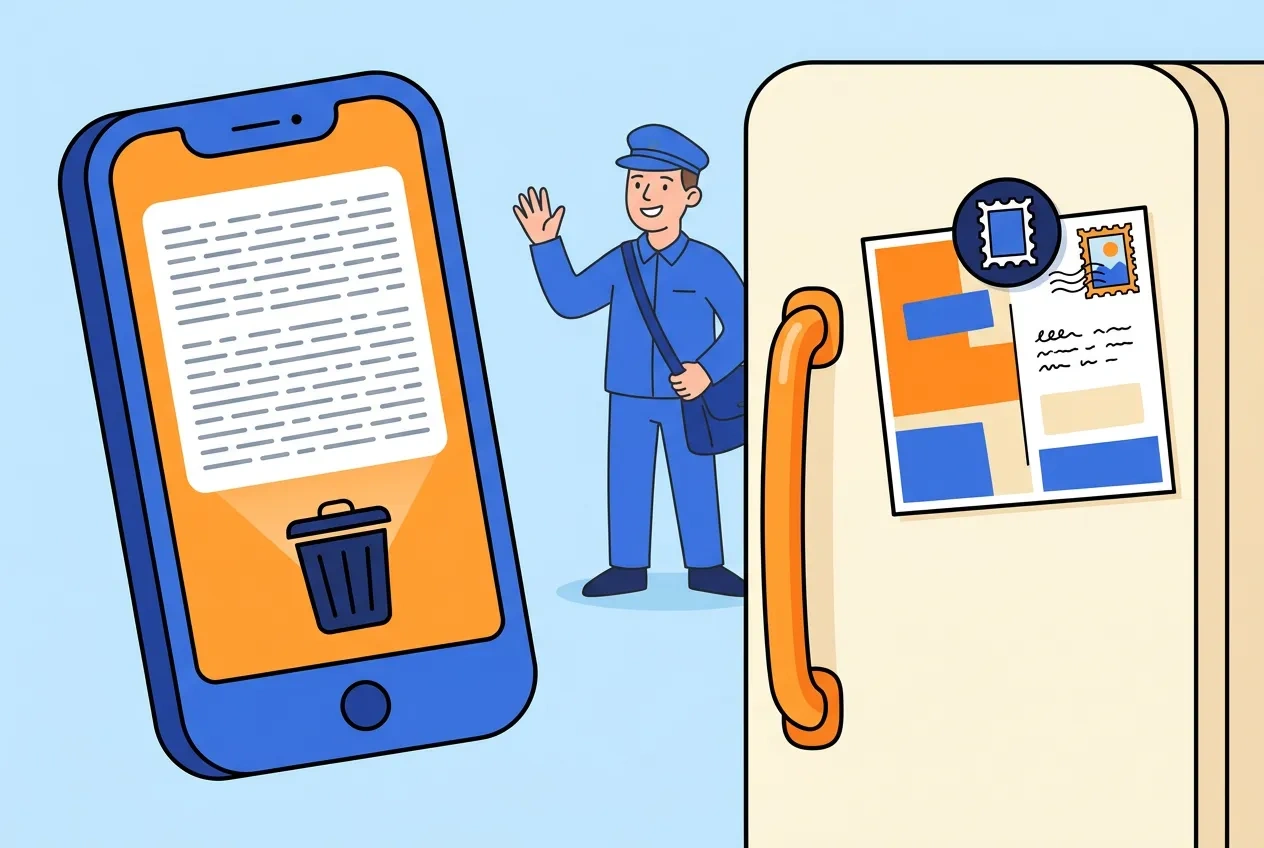
Email marketing is nearly free per message, instant, and easy to measure, which is why every business does it and why every inbox filters it. Direct mail costs real money per piece, takes days to arrive and is harder to measure, which is why fewer businesses do it and why a mailbox has room for your piece. The comparison is not which channel is better; it is what each one is for.
Cost per message and cost per response
An email costs a fraction of a cent to send. A postcard costs printing, processing and postage, every piece. On cost per message, email wins easily. On cost per response, the gap narrows sharply: at a 1% click rate and a 0.1% conversion, an email campaign to 10,000 addresses produces about 10 conversions; a postcard campaign to the same 10,000 households at a 1% response produces about 100 responses. Whether that is cheap depends on what a customer is worth, but for most local services and considered purchases it compares well with paid search and better with social.
Attention and lifespan
Email is read, if at all, in seconds and then buried; most marketing email is never opened. A postcard is handled by definition, read on the way from the mailbox, and often kept: UK research by Royal Mail's MarketReach found that mail stays in the home for days to weeks and is revisited. A card on the refrigerator is an ad that runs for a month. The USPS reports that most households look at their mail every day and that a large majority sort it immediately, which is attention email cannot buy.
Reach
Email reaches only the people who gave you an address and did not unsubscribe, which for prospecting means nobody. Direct mail reaches any household or business in the country from a list built to the criteria you set or a saturation route, with no opt-in required. For acquisition, mail is often the only channel that can reach the exact audience; for retention, email is the cheaper way to stay in touch between mailings.
Measurement
Email measures itself: opens, clicks, conversions, in real time. Mail needs to be set up to measure: a tracking number, a QR code, a short URL, an offer code, and delivery scans to know when it landed. Set up that way, it measures as cleanly as email, with the advantage that a matched holdout group (households that qualified but were not mailed) gives a true incremental lift, which email rarely bothers to compute.
Running them together
The best programs use mail for what email cannot do and email for what mail cannot afford. Mail the offer to the list; email the same households the week the card lands, referencing it; follow with a second card a few weeks later; email again with a deadline reminder. Households that receive both respond at a higher rate than either group alone, and the email is nearly free.
- Acquisition: mail (email cannot reach prospects)
- Nurture and reminders: email
- Win-back of unsubscribed or unresponsive customers: mail
- High-value accounts and considered purchases: mail, then email
- Weekly promotions to an engaged list: email, with a quarterly card
The full figures behind the comparison are in direct mail response rates.
Sources
Answers
Questions this guide answers
Is direct mail more effective than email?
Per message, yes: industry studies put direct mail response several times higher than email click rates, and mail is kept in the home for days while email is filtered or deleted quickly. Per dollar, it depends on what a response is worth; email is nearly free, mail costs real money per piece.
What is the response rate of direct mail vs. email?
ANA studies report direct mail response of about 5% for prospect lists and 9% for house lists, against roughly 1% for email, paid search and social. Actual results vary widely with the list and the offer.
Should I use direct mail or email marketing?
Both, for different jobs. Use direct mail to reach prospects you cannot email, to win back customers who ignore email, and for high-value offers; use email for low-cost nurture and reminders. Households that receive both respond at higher rates than either alone.
Can direct mail reach people who unsubscribed from email?
Yes. Mail needs no opt-in, so a postcard can reach any household or business from a list built to the criteria you set or a saturation route, including customers who stopped opening your email or unsubscribed. Winning those customers back is one of the jobs mail does and email can't, which is why the two work best together.